
Transhumanism Is Everywhere
Is the only solution to happiness more freedom?


Author’s Note: As someone raised in the old world values deemed a “Southern Culture of Honor,” my Dad often emphasized one of its core values, the power of self-restraint, whereas “just because you can, doesn’t mean you should.” Humans evolved through scarcity, but now many live in abundance, leading to a never-ending quest for self-actualization. Today, “my rights” has been translated into hyper-individualism, even if there are negative externalities to the collective. As our secular society abandons natural law and the common good, is the only solution to happiness more freedom?
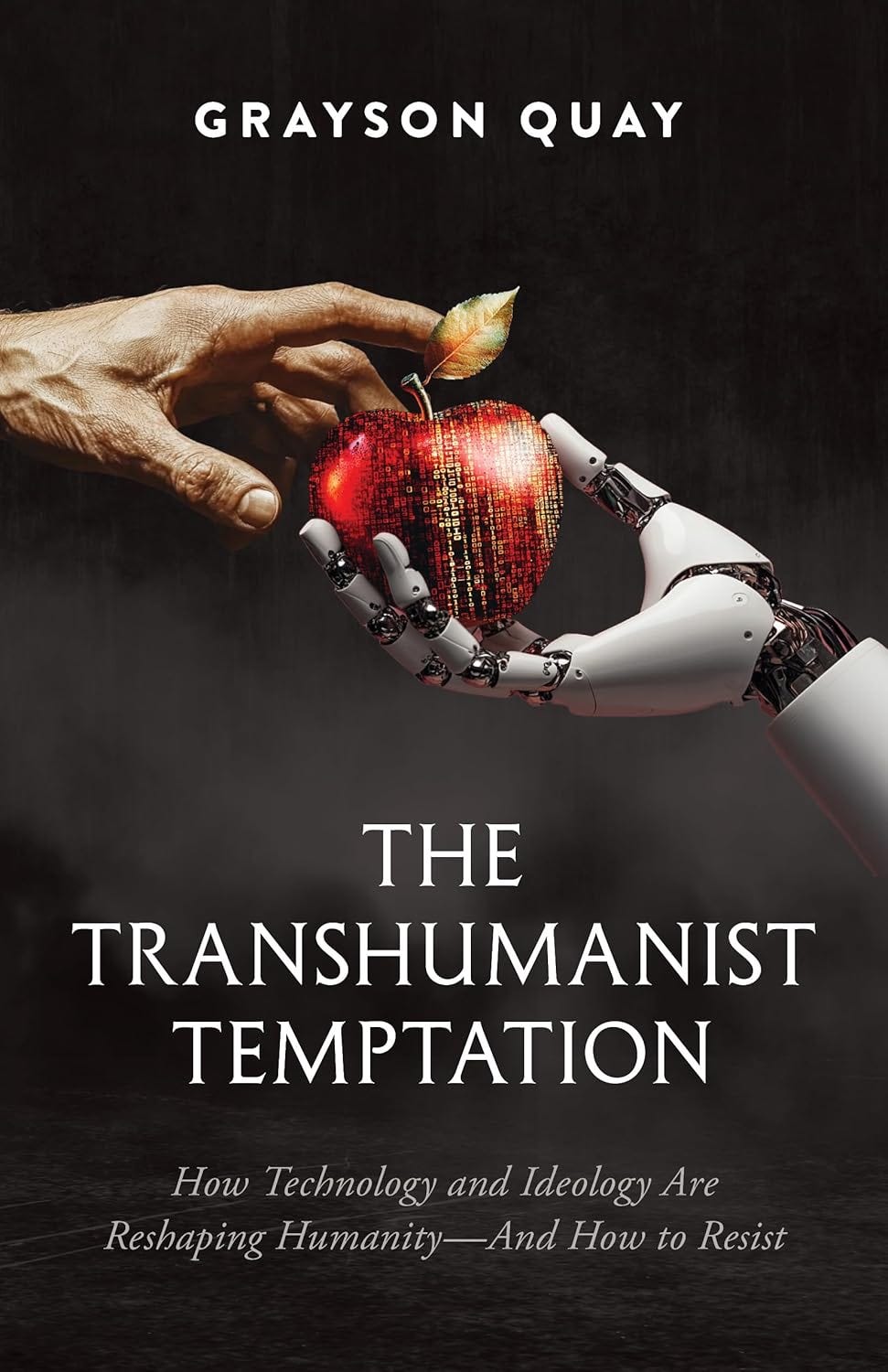
In The Transhumanist Temptation, my friend Grayson Quay views the issue through the lens of faith and scripture as he walks us through the dangers posed by our use of technology to reinvent human nature. His writing cites a range of thinkers throughout history, including philosophers such as Hume and Nietzsche, theologians GK Chesterton and CS Lewis, and futurists such as Ray Kurzweil. Grayson’s book is certainly a thought-provoking read, worthy of attention and an opportunity for us all to reflect on what really matters in life.
I knew I wanted to write a book, but what should I write it about?
During my eight years of writing — both as a freelancer and a full-time journalist — I’d cranked out hundreds of news blurbs, op-eds, columns, and essays, but never a book. I felt like it was time for me to take the next step.
When I reviewed my previous output, however, it seemed frustratingly eclectic. I’d never developed a clear “beat.” Click around my various author pages, and you could find me fulminating against abortion, warning against the dangers of smartphones, exploring how basic questions of political philosophy manifest themselves in the horse race of American elections, critiquing libertarian economics, or wandering off into esoteric musings about reenchantment and spiritual warfare.
These all seemed completely unrelated. But were they? One day, I stumbled across a post from an acquaintance and internet historian named Katherine Dee (more commonly known by her handle, @defaultfriend), in which she predicted that the culture war of the coming decades would be fought not over wokeness, but over transhumanism.
That one tweet acted on my mind like a catalyst, causing previously inert elements to react in new and surprising ways.
All at once, I realized I did have a beat: transhumanism — the use of technology to reshape humanity in ways extrinsic to human nature according to human will. I’d been writing about transhumanism all along.
I saw that, although people tend to laugh off transhumanism as sci-fi speculation or Silicon Valley kookery, it is already all around us and stretches all the way back to Eden, when Satan told Eve, “Ye shall be as gods.”
I decided that the goal of my book would be twofold:
To recreate for my readers the realization I had when I encountered Katherine’s tweet and to call them back to the only thing capable of standing against transhumanism: a natural law framework, preferably informed and sustained by Christianity.
I threw together an outline, splitting my book into five sections, each exploring how the “transhumanist temptation” has warped our relationship with some important aspect of human existence.
Section 1 is titled “Bodies” and deals broadly with bioethics. Section 2, “Reality,” covers virtual reality, augmented reality, artificial intelligence, and how these new technologies discarnate us. Sections 3 and 4 — “Politics” and “Work” — discuss how our political and economic systems leave us vulnerable to transhumanism. Section 5 is called “God” and focuses on the religious nature of transhumanism, the rise of transhumanist spiritualities, and how transhumanism subverts Christianity.
I won’t summarize all five here (I need to leave you with some incentive to buy the book), but a quick overview of Section 1 should provide some sense of how all-encompassing transhumanism really is.
In a 2023 interview, Mary Harrington called the birth control pill “the first transhumanist technology … because it doesn’t set out to fix something that’s wrong with me, like a broken arm … It sets out to break something that’s working properly in accordance with desire.”
Armed with this insight, I applied it to other questions: abortion, surrogacy, transgenderism, and even assisted suicide.
In each case, the practice turned out to be based on what I can only describe as a contempt for human embodiment — transhumanist author Zoltan Istvan writes that “biology is for beasts” — and a demand that medical science cater to this contempt.
If you’re fertile and you don’t want to be, a doctor will prescribe you a pill to disrupt your healthy cycle. If you’re pregnant and don’t want to be, a doctor will kill your healthy baby. If you want a baby but are scared of stretch marks and labor, a doctor will help you outsource the job to a desperate surrogate or (maybe someday) an artificial womb. If you’re male and you want to be female, a doctor will carve you up. If you’re alive and want to be dead, a doctor will kill you.
Historically, the purpose of medicine has been to restore human bodies to the type of flourishing proper to human nature. But thanks to the influence of thinkers like Darwin, Hume, Nietzsche, and Sartre, educated people no longer believe in something called “human nature.” If we are the mere products of blind evolution, then what humanity is cannot tell us anything about what we ought to be or how we ought to live.
A pregnant woman with a teleological view of human nature might infer from it a duty to protect her unborn child. That same woman, corrupted by transhumanism, would think only of her own bodily autonomy and her absolute right to withhold the shelter of her womb from a baby she deemed an unwanted intruder.
With nature out of the picture, only will remains. There is no mode of flourishing (“eudaimonia” in Greek) that is proper to man as man. We have no end (“telos”) but what we choose for ourselves.
This rejection of human nature promises liberation but leads to dystopia. As long as human nature remains a constant, there are limits on how inhuman society can become. But once governments and corporations gain access to technologies that can reshape our bodies and minds according to their priorities, we will be putty in their hands.
Ted Kaczynski put it best: “In the future social systems will not be adjusted to suit the needs of human beings. Instead, human beings would be adjusted to suit the needs of the system.”
It’s already happening. Women freeze their eggs to keep their careers on track. Rowdy middle school boys get Ritalin prescriptions. Embryo screening is here already, and genetic engineering is just over the horizon.
Nobody (at least for now) will force you to accept these technological tweaks to your humanity or impose them on your offspring, but the state, market, and culture will certainly “nudge” you to do so — and punish you if you refuse.
Those who comply (or whose parents comply before they’re even born) will suffer an even darker fate: they will know that they have ceased to be people and have become products.
This is the choice ahead of us: either we recover the idea of human nature and deploy technology only in ways that promote the flourishing proper to it, or we succumb to the transhumanist temptation and usher in the abolition of man.
 | A guest post by
|