
The Anti-Nepotism of 96
And the Klan rally we all forgot about

Author’s Note: This post was pulled and modified from a draft of Millrat.
Starting Little League
Thirty years ago: Over the course of four summers, I played Little League baseball—three years in the minors and one in the majors. As soon as the season finished, Mom wedged in swimming lessons at the Lake Station city pool just before sending me south to visit the grandparents in Kentucky. As much as I loved spending time in family pools and at the beaches of Lake Michigan, I dreaded swimming because I almost always finished last in our lessons… behind all the girls.
Baseball was a different story.
Less than a year after relocating to Northwest Indiana from Virginia, I attended my first game in 1990 at Old Comiskey Park. It was one of the last games the White Sox played at the stadium before the new one opened a year later. My dad, his friend Tony, and I sat in the first row halfway between first base and right field.
At some point during the game, a pop-up fly ball headed in my direction but was easily caught by the right fielder. He walked up and handed me the ball. The player’s name was Sammy Sosa, and he instantly became my favorite. Less than two years later, he was traded to their biggest rival, the Cubs. Few things could be worse, and for many years it forced me to be “nonpartisan” in the Crosstown Classic. Despite this travesty, I was in love with the game.
In Little League, my position rotated between catcher, pitcher, and second base—all high-action roles. Catcher was my favorite because it felt like I was in control of the game. Being a perfectionist, I found pitching too much pressure, and second base provided too many hot ground balls that found my chest more often than my glove.
Dad attended all the games and had no shortage of comments from the stands. He never got out in front of the coaches, but he knew when he needed to get my attention. By some magic of psychology, Dad always knew when I wasn’t working hard and shouted, “No loafing!” on many occasions.
The Klan Comes to Town
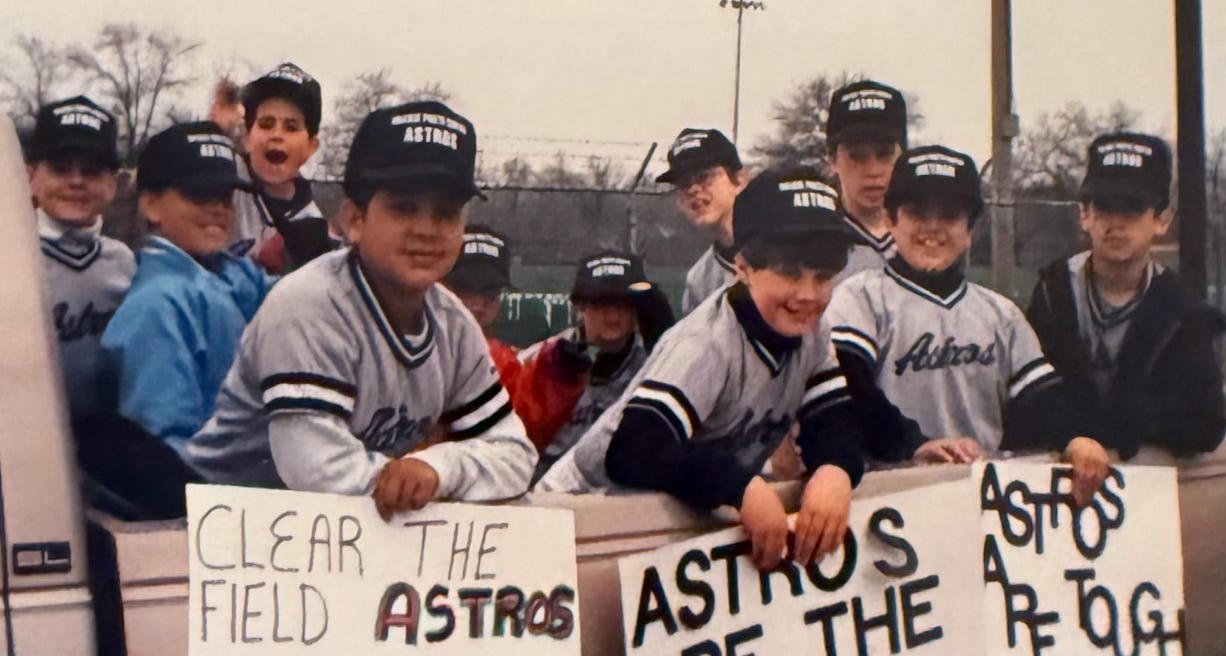
Just before my last year playing, Dad was asked to coach my team. Based on his relationships with the other parents, it was a no-brainer. That spring he paid for me to go to a pitching camp, but I would never be as good as my older cousin Scott, who threw multiple no-hitters and took his team to state. Also, after years of using a beat-up mitt with Jim “Catfish” Hunter on the palm, my extraordinarily frugal old man bought me a new mitt. I still recall how meticulous he was about breaking it in with mink oil.
Dad took me to the batting cages for practice just about every weekend before and during the season, but I also think he was looking for an excuse to go window-shop at the ‘Big R’ store, a farm and ranch retailer that was next door. One Saturday, Dad changed plans and said we weren’t going to the cages because there was a protest planned nearby at city hall. I didn’t know what he was talking about, but we saw elements of the event on cable TV.
That May, the Ku Klux Klan (KKK) held a rally (long YouTube here) to encourage members to participate in the ‘96 presidential election. They claimed illegal immigrants were taking over the country, along with the collapse of law and order, and that the only tool they had to fight back was democracy. It wasn’t until I pulled out that dusty Encyclopedia Britannica book set at home that I finally learned what the KKK was all about. There were other rallies in the state that year, but all were dwarfed by counter-events.
I did not understand the hate, and it was a confusing time to grow up in the lower socioeconomic class of the analog world (pre-internet), especially when it came to matters of race. The kid programming I watched on Nickelodeon included All That, Kenan & Kel, and My Brother and Me, the last providing a humorous exercise in “code switching.” Family-centered cable TV shows like The Cosby Show, The Fresh Prince of Bel-Air, Martin, Family Matters, and In Living Color not only presented positive images of Black Americans and their families but often embedded a cultural education in the message.
But there was another side of the coin in ‘96. Almost all of my peers had older siblings, and we all wanted to be cool like them, so following their interests in music was a natural start. Fifth grade was the first year compact discs (CDs) reached our hands, and I was the last to join the party. My white friends brought in albums from the likes of KoRn and Limp Bizkit, whereas my minority friends brought in the albums of Bone Thugs-n-Harmony, Tupac, and The Notorious B.I.G. The latter two rappers would be murdered just months after I was introduced to them. All of the albums had Parental Advisory stickers on them due to the prolific amount of cussing, but it was rap that would introduce “nigga” into the lexicon of our generation.
The experiences they sang about were hard to reconcile with what I saw on TV. Either way, it sent the speech of us blue-collar folks in a very different direction than that of the middle- and upper-class Americans. There would be a rude awakening when I arrived at college. Integrating culturally when changing social class is hard, and it’s best captured in the memoir Limbo: Blue-Collar Roots, White-Collar Dreams.
Another social challenge I had related to rules within my own class. Dad often gave other players with less financial means a ride to the ballpark; one in particular was Erique, who lived in the part of Lake Station we all called “Little Mexico.” He didn’t believe in allowing simple barriers to keep kids from sports. One time he dropped me off at the field early to set up while he picked up another player. One of my peers was behind the dugout smoking a cigarette, to which I said, “Smoking is bad for you,” as if I were Rod & Todd in The Simpsons.
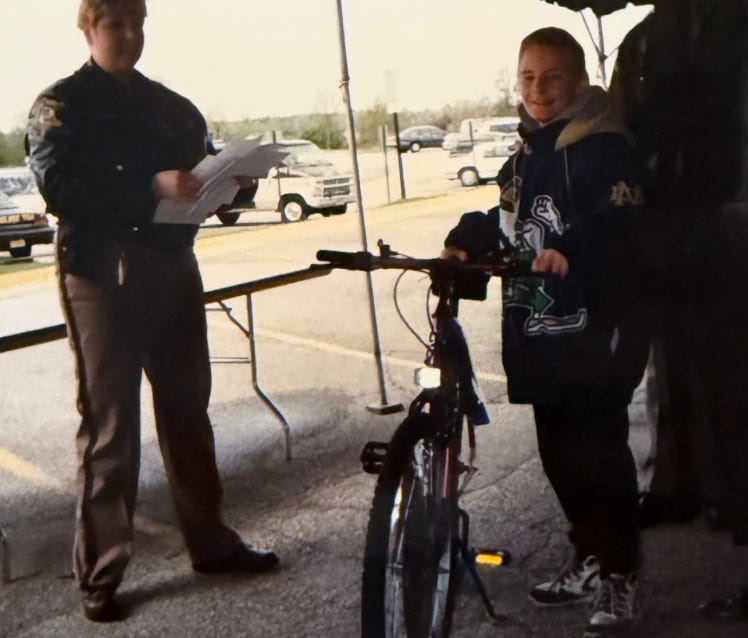
He called me a nerd and loser, which was crushing because he was popular and I valued his opinion. Earlier that year, I won an 18-speed bike through the D.A.R.E. program with an essay about the importance of staying drug-free, but I would quickly learn that being a rule-follower and a goodie-goody diminished one’s social standing in the blue collar working class. One of my Mexican friends was kicked out of the program when they found out he was growing marijuana on the 6th-grade playground. To me, it was unthinkable to defy authority.
Nepotism Need Not Apply
At the end of the season, our team finished second, losing out in a three-game final for the championship. I cried for three nights about it. It was then I learned something about myself: I absolutely hate losing far more than I love winning.
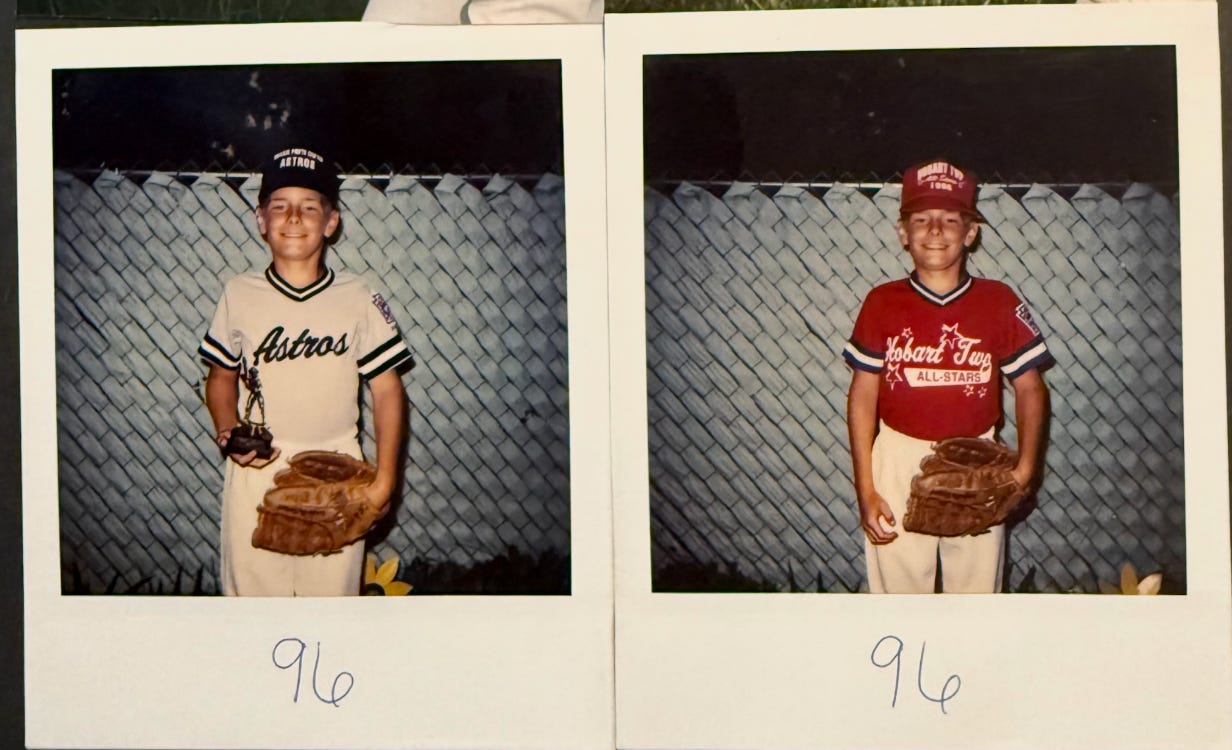
Players and parents loved Dad, and they asked him to coach the All-Star team. Shortly thereafter, I was named to the team. Some players accused me of favoritism, but as the facts would bear out, every coach voted for me to be on the team… except my dad. Before practice began, he said, “You are too young and immature to be on this team. It’s for 12-year-olds and exceptional 11-year-olds… and you aren’t either.”
At practice, Dad went out of his way to ensure favoritism was never an issue. I had to bat last, run extra laps, and receive “extra” constructive feedback during drills. For the first time ever, I rode the bench for two entire games. I was only put in to bat once, after we were down by 15 runs in a shutout. I was one of the few players to make contact with a 68 mph fastball. Our pitching machine only went to 55, and I could barely hit that. Understand, that is lightning speed with the mound just 46 feet away.
Before every game, Dad said, “I expect you to give 110% and leave it all on the field.” Winning was important but not the ultimate point of the exercise. Effort mattered more. To Dad, sports were more than a competition; they were about developing character. After the game ended, we would review what I did right, what I did wrong, and where there were areas to improve. “What did you learn?” was a recurring question. Sour grapes, whining, and excuses would not be tolerated.
He also wanted me to get used to unfairness as the standard and to understand “nothing given, everything earned.” Don’t bask in the glory of success, but don’t sulk in defeat either. Work ethic and good sportsmanship were the real metrics of what mattered.
He was always critical of me in public but would praise me in private. While Mom saved every one of my participation ribbons and trophies, Dad said we were rewarded by lessons learned, not for merely showing up. Bobby Knight was his favorite coach, so in like fashion, Dad found loyalty and dedication to be the most important things he looked for in the players he mentored.
Chinese Flea Market
At the last game of the regular season, Dad won the 50/50 raffle, the prize being several hundred dollars. I’d be going into basketball season that fall, not just in school but also in a Saturday league. Dad knew my feet were growing and I needed new shoes. We went over to the Miller Flea Market at the end of Route 51 in Gary, which was packed with vendors selling goods of questionable origin.
Several of the sellers were Chinese, and outside of restaurants, this was really the only other place one would come across such people where I grew up. Being a fan of Doctor J, Dad came across a pair of “new” Converse that he liked. The high-tops were so tall that the shoes had longer laces than a military boot and were just as heavy. They were totally unfashionable compared to the Jordan 11 and Rodman Air Worm that my friends had, but the price was right. They stickered at $30, but he told the lady he only had $18 on him. I said, “Dad, that’s not true, you just won a raffle.” He rolled his eyes, bit his tongue, and gave me the look of death. After some haggling, the lady took the $18 for the shoes.
In the truck, he first scolded me: “You need to learn how to keep your mouth shut.” But per usual, it was lesson time. He said that when it came to wheeling and dealing, I needed to keep cash in both pockets. On one side would be what I wanted to pay, and on the other side would be the extra for what I was willing to pay for something. Over the years, I would watch him maintain discipline and drive hard bargains from both the buying and selling sides.
Most of the things we bought—whether it was my two-sizes-too-big hunting clothes from the Army-Navy Surplus store or some fishing trinket at a summer garage sale—he always seemed to come out ahead. That fall, Dad would be the only parent to show up and stay during my basketball league’s evening practices, which I found embarrassing. Sitting on the opposite side of the bleachers, he added unsolicited commentary to my development.
Different sport, same expectations. He was molding a young man in the only way a father could. It’s a friendly reminder that the values of work ethic, discipline, and good sportsmanship are free.