
Robert’s Reads – Christmas List 2025
Here are 10 book ideas for your Black Friday shopping list

After eight years in Washington, D.C., I relocated to Indianapolis on December 21st, which is the birthday of my Papaw Hollis (born 1931), whom I write about in this Substack. The U.S. Senate finished its business at 1:30 a.m., and I left in my U-Haul from Navy Yard at 3:45 a.m., making a pitstop just outside Pittsburgh to meet with author Ed Latimore for breakfast. He has a guest post here, and I’ve featured his new(ish) book on a list here.
Of all the things I had to move, the books were the worst. Although I have tried e-books since about 2012, I still prefer physical copies. For anyone relocating, I highly recommend these blue tarp zipper bags from Amazon, as they made transportation much easier. Loaded, I put one on the scale, and it was just shy of 100 pounds.
This spring, I purchased a townhouse just a block off Lake Michigan in Gary, Indiana. My real estate agent was a cybersecurity fellow in President Biden’s White House through 2024 – always interesting how my relationships and network come full circle. My place looks across the street into the Indiana Dunes National Park, which received its designation in 2019 after 100 years of advocacy. As a student of “Sand & Steel,” a juxtaposition in its own right, expect to see more writing about the founding of Gary, U.S. Steel, and the modern birthplace of ecology, founded in the dunes.
When it comes to finishing my memoir, Millrat, progress has been painfully slow this year with the job, but the longer I wait, the better it gets. With each book read, I always find some valuable takeaway about my faith, family, or community that needs to be noted.
This year, I’ve been able to read over 60 books. I’ve tried to select the 10 that are most applicable to the general public, even though most of my selections serve as background to the memoir. Given my family’s 200+ year history in western Kentucky, I went down a rabbit hole researching black and white southern migration in the 20th century. That work became the inspiration for my TEDxGary talk, delivered on October 18 at Indiana University Northwest (IUN). The talk was titled, The Power of Storytelling: Lessons From The Agrarian Tradition.
My goal going into 2026 is to get published nationally in a few journals and magazines as a way to assert myself as an authority on a few topics. The purpose is to make my book proposal more attractive to traditional publishers. With that being said, here’s what I’ve got for you in 2025. As always, the complete list of what I read is available here on Goodreads.
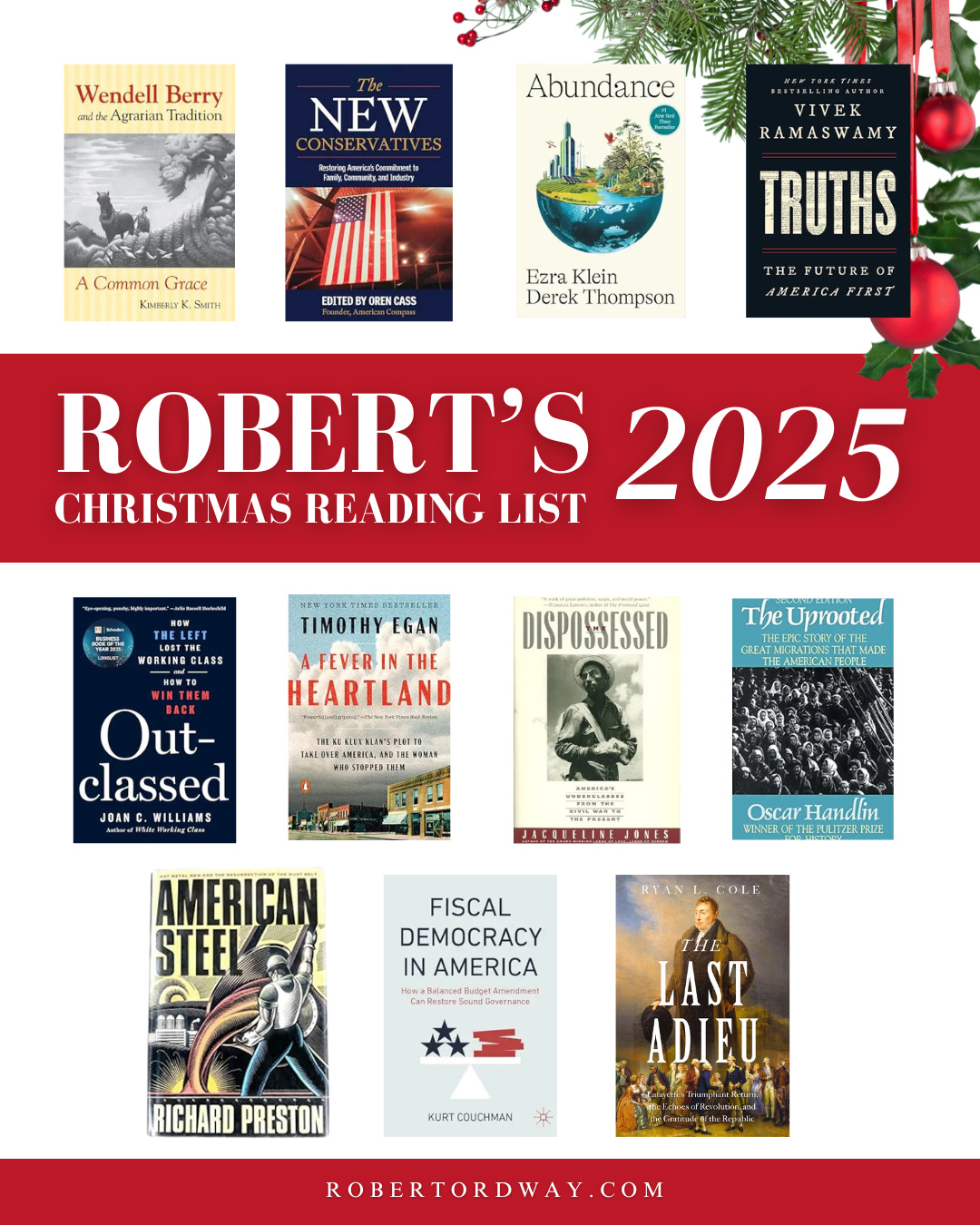
Wendell Berry and the Agrarian Tradition: A Common Grace, Kimberly B. Smith (2014)
Although not new, this was the most transformative book I read this year. Wendell Berry is renowned for his writings on farming and conservation, and is highly regarded by environmentalists. This book examines his philosophy and contributions to environmental theory and politics. As of this writing, he is 91 and still living in Henry County, KY. I visited The Berry Center recently and hope to get one of his books signed in the coming months. Despite being raised in the north, my perspective on such issues was shaped by the Ordway lineage in western Kentucky and aligned with Berry’s work in The Unsettling of America: Culture & Agriculture.
The New Conservatives: Restoring America’s Commitment to Family, Community, and Industry, edited by Oren Cass (2025).
This book is a collection of essays that were previously published in various outlets, primarily in the D.C. area. The authors critique policy from the market, labor, globalization, China, industrial policy, family, worker power, and education. The approach is one that questions the history of economists and policy makers, where the only real end game is more consumption and increased GDP. As a member of American Compass myself, I appreciate some of the contrarian views. Highly recommend Oren Cass’s book, The Once and Future Worker: A Vision for the Renewal of Work in America (2018).
Abundance, Ezra Klein and Derek Thompson (2025)
Can’t say I cared for Ezra Klein’s Why We’re Polarized (2021) because he is definitely one-sided in his partisan commentary, but I was recommended this read by a few folks, so here we are. Given my background in housing policy, I appreciate his thoughts on how we can increase supply to get prices down, as this will be a defining issue for younger generations. Now it was a bit humorous that (as a self-defined liberal) he blames too many rules and regulations of the 1970s as a reason why we are in our current situation (eg: California). The ‘abundance’ mindset has been explored in other areas, such as sales, psychology, etc.
Truths: The Future of America First, Vivek Ramaswamy (2025)
I tend not to read political books written by folks running for office because they are usually just loaded with platitudes, but I really liked Nation of Victims (2022), given my memoir is rooted in rejecting the victimhood narrative. What I appreciated in this book is that Vivek is an offensive player, answering “What are we for?” instead of being Mr. No. He is six months younger than me (we both turned 40 this year) and also from the Rust Belt, so I can see we are both shaped by events like 9/11, the Iraq War, and the Great Recession.
Outclassed: How the Left Lost the Working Class and How to Win Them Back, Joan C Williams (2025).
I actually emailed Joan after reading White Working Class: Overcoming Class Cluelessness in America, and she would have put me in this new book had it not already gone to print. The author is really good at identifying problems within the Democratic Party, but even as part of the Brahmin Left, to me, she still has her heels dug into some of the niche identity politics that I can say would not resonate in the multiethnic working-class community in which I was raised.
A Fever in the Heartland: The Ku Klux Klan’s Plot to Take Over America, and the Woman Who Stopped Them, Timothy Egan (2024).
As a Hoosier, I think reading about the KKK is a mandatory exercise given their influence on state politics in the 1920s. After reading James H. Madison’s The Indiana Way: A State History (2000) in 2010, I picked up Hoosiers: A New History of Indiana (2018) earlier this year, but haven’t read it yet. Instead, I finished his other book, The Ku Klux Klan in the Heartland (2020). Egan’s book gained significant traction and became a New York Times bestseller. While books about the Klan are not new, I enjoyed the highly detailed storytelling of different characters, issues, and rivalries. This era in American history deserves more attention because it’s often oversimplified to drive certain political narratives. There is always more than meets the eye when you finally get a peek behind the curtain.
The Dispossessed: America’s Underclass From The Civil War To The Present, Jacqueline Jones (1993).
This was a random find during my deep dive into black and white southern migration. Academics promoting a specific and oversimplified political narrative miss opportunities to unify folks through shared experience. This book is filled with a lot of nuance, but my takeaway is that both black and white sharecroppers had much in common as the planter class exploited them. My takeaway is that intergenerational wealth has never been a thing for most Americans, even for those who owned their land like my family.
The Uprooted: The Epic Story of the Great Migrations that Made the American People (1973)
It’s no secret that Gary, Indiana, is my favorite city with a fascinating history. Early dives into the 50+ ethnicities that arrived at the turn of the 20th century always send me down a rabbit hole. It’s important to know that the U.S had virtually zero immigration policy from 1800 to 1900. This book gives a finger-tip feel into the daily lives of these people and what they did to survive. The documentary Forgotten Ellis Island encapsulates the harsh realities of discrimination coming to America and early practices of eugenics.
American Steel: Hot Metal Men and the Resurrection of the Rust Belt (1991)
U.S Steel laid off my dad during their mass consolidation in the 1980s, but at the same time, a new company came on the scene. This book blends storytelling with history to tell how Nucor entered the steel business in the late 80s, took a very different turn from its business model by bringing electric-arc furnaces to the sheet metal industry, and built its first large plant in Crawfordsville, Indiana. They are now the largest steel manufacturer and recycler in North America. It was neat to meet some of their staff and lobbyists earlier this year.
Fiscal Democracy in America: How a Balanced Budget Amendment Can Restore Sound Governance, Kurt Couchman (2025)
Okay, I had to have one really nerdy read in this list. Kurt Couchman is a friend and served as my right-hand man for six years during my tenure in the U.S. Senate. I was an early reviewer of this book in draft form and believe it provides an excellent foundation for those looking to understand how the federal government budgets and what is needed to put our country back on a path to fiscal solvency. You won’t find a more thoughtful human being in such an esoteric space.
Bonus - The Last Adieu: Lafayette’s Triumphant Return, the Echoes of Revolution, and the Gratitude of the Republic, Ryan L Cole (2025)
Completely forgot this on my original post due to how busy I have been this fall but I would remiss if I didn’t include this book written by a fellow Hoosier.
Lafayette was a French military officer and politician who volunteered to join the Continental Army, in American Revolutionary War. Although born of high status, was ahead of his time in championing the abolition of slavery and his return to the U.S. as the “Nation’s Guest” was well received as he travel all (then) 24 states. In October, I attended a great interview Ryan had with Indiana Historical Society CEO, Jody Blankenship. To play off the subtitle of ‘gratitude’, I am thankful for all the writing help Ryan has given me over the years.
Robert Ordway's Newsletter is a reader-supported publication. To receive new posts and support my work, consider becoming a free or paid subscriber.